Add Row
Add Element
cropper
update
Bay Area Business
update
Add Element
  • Home
  • Categories
    • Business News
    • Retirement Planning
    • Investing
    • Real Estate
    • Tax Planning
    • Debt Management
    • Bay Area Business Spotlight
    • Tech Industry Trends
    • How I got started
    • Just opened
    • Sustainability and Green Business
    • Business Financing
    • Industry Spotlights
    • Bay Area News
    • Bay Area Startups
  • AI Business Tech
6 Minutes Read

Kona Ice Entrepreneur: From Classroom to Sweet Success with Derry Gutierrez

By James Lamont

The Unexpected Sweet Spot: From Classroom to Kona Ice Entrepreneur

Ever imagined a career change as vibrant and refreshing as a rainbow shaved ice on a scorching summer day? For Derry Gutierrez, that wasn't just a fantasy. This isn't your typical business story; it's about a passionate educator who traded lesson plans and report cards for the delightful chaos of flavor stations and beaming smiles. Derry, the owner of Kona Ice of San Rafael, didn't follow a traditional entrepreneurial path. His journey from the structured world of early childhood education to the mobile world of frozen treats is a testament to how unexpected backgrounds can bring a unique and human touch to the business landscape. How did a deep understanding of children's joy and community needs blossom into a thriving Kona Ice franchise right here in Novato and the wider Marin County area? Get ready to discover a story where passion for people flavors every scoop.

A Journey Rooted in Community: Derry's Backstory and Entrepreneurial Spark

Derry’s story isn't just about starting a business; it's about building upon a lifelong connection to community. Moving from Peru to the vibrant landscape of Marin County at a young age, Derry’s early experiences instilled in him a deep appreciation for the power of local bonds. He reflects on his stepfather’s t-shirt business in the Bay Area, sharing, “I grew up watching my stepdad run his t-shirt business in San Francisco, and as I got older, I started helping out. I never saw myself as a ‘salesman’—to me, it was just about connecting with people.” This early exposure planted the seed for his entrepreneurial spirit. However, Derry’s path took a meaningful turn into education, where he has spent the past 15 years working with children—most notably in Marin City. “I struggled as a young kid and adolescent in school and lacked trusting relationships with educators,” he shares. “So I wanted to make a meaningful impact on youth by creating those relationships rooted in trust, kindness, and support. Sometimes, kids just need an adult to listen to them.” His words reflect a deep commitment to nurturing and empowering young lives. It was also important to him to be a positive role model for boys, especially in environments where men are not typically present—like classrooms and preschools. He wanted to represent Latino men in the community with pride and purpose, showing that men in early childhood education can be kind, attuned to children’s needs, and joyfully engaged. This dedication to community never wavered. Even after relocating to Novato and taking a position at the College of Marin’s preschool, his drive to create something of his own—something rooted in his values—remained as strong as ever.



The "Aha!" Moment and Taking the Plunge

The idea for Kona Ice wasn't a sudden lightning bolt but rather a gradual realization, sparked by a familiar family treat. Derry recalls, “We used to see Kona Ice at events all the time, and our kids were always excited to get shaved ice. We ended up collecting all the color-changing cups—they became a fun, joyful presence in our home.” The idea of owning a Kona Ice franchise lingered in the background, a potential blend of his business aspirations and his love for bringing smiles to faces. Like many aspiring entrepreneurs, Derry had some initial hesitation about the financial investment. But it was the unwavering support of his wife, Dori, that became the turning point. “My wife was very supportive and said, ‘If this is what you want to do, then let’s go for it,’” Derry recalls. Her encouragement played a crucial role in helping him take that leap of faith into small business ownership in Marin County.

More Than Just Shaved Ice: Key Turning Points and Innovative Practices

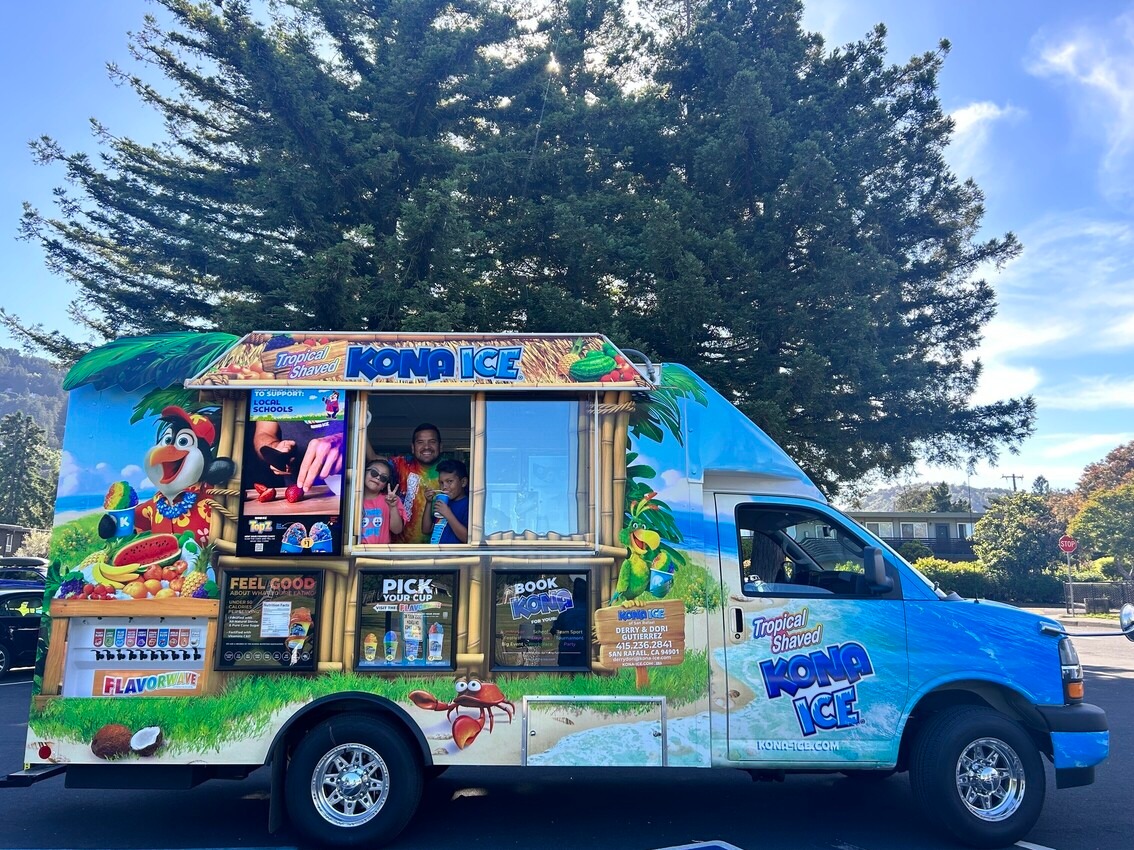
Derry’s transition from the classroom to the Kona Ice truck wasn't a complete departure but rather an evolution, leveraging his existing skills in unexpected ways. His strong ties to the local school community in Marin County quickly became a valuable asset. “When schools find out I’m a teacher—or that I’ve taught—they’re like, ‘Oh wow, where?’” he says, highlighting the instant rapport and trust his background creates. He also frequently runs into former students at events and loves hearing familiar shouts of “Hey! Teacher Derry!” or “Hey! Coach Derry!”—small moments that reflect the lasting connections he’s built over the years. Derry quickly realized that his business was about more than just serving shaved ice—it was about creating positive experiences and giving back to the community. His innovative “give back” model, which offers schools a percentage of sales or a discount, has become a cornerstone of his success. “Kona Days at schools have been especially successful in helping raise funds,” he explains. “We set up a day or two each month to serve Kona Ice on campus and provide give-back checks along the way. This year, we raised just over $1,000 for San Jose Middle School in Novato through these Kona Days!” His approach highlights the win-win partnerships he’s built with local schools, blending community engagement with small business impact.


The Secret Ingredients: Unique Selling Points and Differentiators

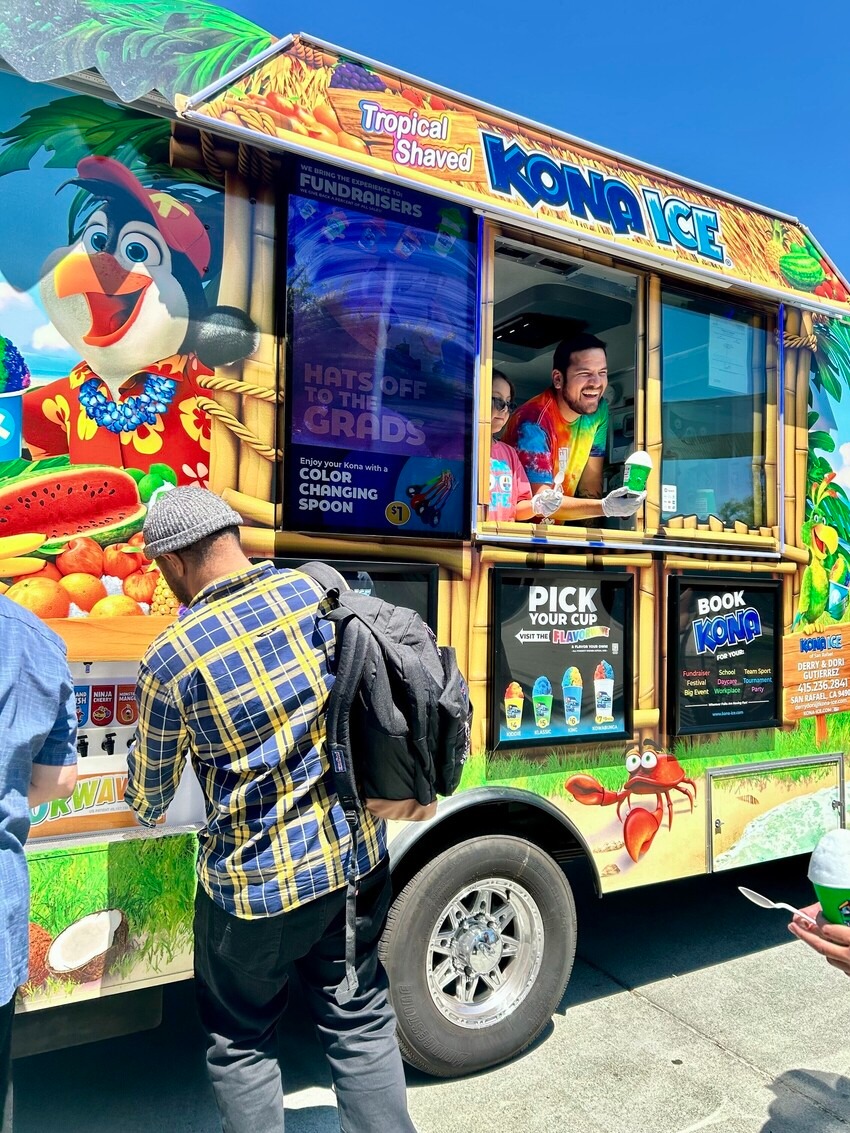
What makes Kona Ice of San Rafael a local favorite isn’t just the wide variety of delicious flavors—it’s the personal touch and genuine care that Derry brings to every interaction. For him, it’s about creating an experience, not just a transaction. “To me, that’s what it’s all about—the experience and the connections you make with people” he shares. His commitment to connecting on a personal level—even if it means the line moves a little slower—deeply resonates with the community. “I can honestly say that with each customer I meet, I’m making a connection with them,” Derry affirms. That empathy shows up in small but meaningful ways, like offering a free replacement when a child accidentally drops their cup. Beyond customer interactions, Derry’s commitment to building long-term relationships with local organizations, like Dominican University, sets his business apart. Interestingly, the business has also brought an unexpected personal reward: the gift of time. “One of the many things the business has given me is time—time to take my kids to school, volunteer in their classrooms, and coach their teams,” Derry reflects, grateful for the flexibility it offers to be present in his children’s lives. This powerful blend of community focus, meaningful connections, and strong family values is what makes Kona Ice of San Rafael not just a business, but a beloved part of the local community.

Scoops of Wisdom: Actionable Insights for Aspiring Entrepreneurs

For those dreaming of starting their own ventures, Derry offers valuable insights gleaned from his own journey. One key takeaway is the importance of leveraging your existing skills and passions in unexpected ways. His background in education, initially seemingly unrelated to food service, became a powerful tool for connection and community building. He emphasizes the power of genuine community engagement, advising aspiring entrepreneurs to look beyond just sales and focus on building meaningful relationships. Derry’s experience highlights that a business can be a vehicle for positive impact, not just financial gain. His "give back" model with schools demonstrates how aligning your business with community needs can lead to both success and fulfillment. Ultimately, Derry’s story underscores the importance of embracing unexpected opportunities and infusing your business with your unique personality and values to create something truly special in your local market.


A Recipe for Success: Concluding Thoughts

Derry’s journey with Kona Ice of San Rafael is a vibrant example of how passion, community spirit, and a willingness to embrace the unexpected can lead to a fulfilling and impactful entrepreneurial path. His story reminds us that success isn't always about following a traditional blueprint; sometimes, the most rewarding ventures are those that blend our unique backgrounds with a genuine desire to connect with and serve our communities, whether it's the neighborhoods of Novato, the schools of Marin County, or beyond. So, the next time you see the colorful Kona Ice truck, remember Derry's story – a reminder that business can be both sweet and meaningful, one cup of shaved ice and one community connection at a time. Want to know where they’ll be next? Follow Derry and Dori on Instagram at @konaice_sanrafael to catch their next serving location.


Bay Area Business Spotlight

432 Views

0 Comments

Write A Comment

*
*
Related Posts All Posts
02.13.2026

Built on Grit: How a Northern California Supply Leader Quietly Doubled Revenue

From loading trucks in the yard to answering midnight emergency calls from contractors, this is the story of a Northern California supply company built through consistency, responsiveness, and long-term relationships. Over the past decade, the company has doubled its revenue while competing directly with national suppliers—not by undercutting pricing, but by out-executing them on service.This is a story of measured growth, operational pressure, and leadership formed through experience rather than title.An Early Start: Education and DisciplineThe path into ownership began early. High school was completed at 16 through a proficiency exam, followed immediately by full-time college coursework. Mathematics came first, then two years at Long Beach City College, before transferring to Sacramento State and graduating in 2006 with a degree in government.The academic track built structure, discipline, and analytical thinking. But the most practical education came afterward—in the family business.Learning Every Role Before LeadingThere was no direct path to the office. The work began in the yard:Loading contractor trucksMaking deliveriesWorking the front counterMoving into inside salesTransitioning to outside salesSpending time in bookkeepingEach role built operational awareness. It created direct exposure to contractor timelines, job site realities, and the pressures customers face daily. That ground-level experience later became one of the company’s structural advantages. A Rapid Transition Into LeadershipIn 2013–2014, leadership shifted suddenly when the founder became seriously ill. Responsibility moved quickly, well before formal ownership followed a few years later.At the same time, life outside of work was expanding—marriage, family responsibilities, and executive leadership converged all at once. The role changed overnight.It was no longer primarily about selling materials. It became about insurance carriers, legal matters, utilities, regulatory compliance, payroll, vendor negotiations, and long-term strategy.Different role. Different pressure. Different level of accountability.Strategic Refocus and Measured ExpansionA decade ago, the company’s foundation centered heavily on geotextile fabrics for road construction. That category remains active, but the strategic focus shifted toward erosion control—specifically straw wattles, which are required on virtually every regulated construction site.With tightening state environmental requirements, erosion control became both a compliance necessity for contractors and a stable growth lane for the business.The results over ten years:Revenue doubledVendor relationships expandedProduct lines broadenedService territory stretched from San Jose and San Francisco north through Sacramento, Lake County, and as far as WillitsThe primary customer base today includes licensed general engineering contractors, road builders, and dirt-moving firms across Northern California. Competing With National Suppliers Through ServiceThe company’s primary competition is not local—it is national big-box distributors with significant purchasing leverage.Matching pricing at scale is not realistic. Volume discounts at the corporate level make that battle unsustainable.Instead, the business competes on responsiveness.Leadership answers calls at six in the evening.Emergency materials get loaded after hours.In one case, a midnight call led to opening the yard so a contractor could reopen a torn-up roadway before morning commute traffic.This level of access does not exist inside a corporate call center structure. It exists in relationship-driven businesses.Operational Reality: Staffing and Cash FlowThe largest ongoing pressures are not products or demand—they are internal.Managing 10–12 employees across two locations requires constant oversight. Cross-training is vital because single-role dependency creates risk. Retention, coverage gaps, and training cycles directly impact daily operations.Cash flow adds another layer. Growth requires inventory. Inventory requires capital. Growing too quickly can destabilize a company that is otherwise healthy.The target is steady expansion—approximately 10% per year. Enough forward motion to remain competitive, without overextending. Marketing, Metrics, and Data ClarityMarketing strategy has evolved as well. Under the guidance of a general manager, the company invested in SEO and professional content marketing. Posts are distributed consistently across platforms such as LinkedIn, and traffic data shows positive movement.However, impressions alone are not meaningful.Traffic must convert.Comparative benchmarks matter.Revenue attribution matters.For a numbers-driven owner, marketing must translate into measurable performance—not surface-level engagement statistics.Industry Leadership and Community InvolvementBeyond daily operations, leadership has extended into professional and community organizations.Recognitions and affiliations include:2011 Young Professional of the Year – International Erosion Control Association (IECA)Board Member – Western Chapter of the International Erosion Control Association (WIECA)Board Member – Engineer Contractor’s Association (ECA)Board Member – Maintenance Superintendent Association (MSA)Participation in Sonoma County Honor FieldThese roles reflect long-term involvement in the broader construction and erosion control industry, not just internal company growth.Life Outside the YardThe business operates alongside a full personal life—a blended family with four children, two biological and two bonus, plus becoming a grandparent at 42. A marriage that traces back to junior high school.And recently, something rare: a full two-week shutdown for a trip to St. John in the Virgin Islands—the first true extended break in more than 15 years.Stepping away is difficult. It is also necessary.Closing PhilosophyWould the journey be repeated?Yes.The core principle remains simple:Your handshake matters.Your integrity matters.Your word matters.In an industry built on contracts and compliance, trust still determines who gets the call when something goes wrong at midnight.And in Northern California’s construction supply market, reliability continues to be the strongest competitive advantage available.You can visit Stevenson Supply's website at stevensonsupply.net/

02.13.2026

From Prison Walls to Changing Lives: How Paul Casey Built A Better You Fitness

When you hear stories about overnight success, they rarely include the messy middle—the setbacks, the fear, the moments where quitting would have been the easier option. Paul Casey’s journey is different. It’s raw, honest, and deeply human. From a childhood marked by instability to spending a decade in prison, Paul’s path to founding A Better You Fitness in Hayward, California, is not just a business story—it’s a story of transformation.What makes Paul’s journey so powerful isn’t just where he ended up, but how deliberately he built his life and business, one hard decision at a time.A Childhood That Could Have Defined HimPaul grew up in a broken home. His mother struggled with drug addiction, and his father was verbally and physically abusive. At a young age, Paul began using drugs himself and eventually cycled through juvenile hall and boys’ homes. That trajectory ultimately led to a 10-year prison sentence.For many people, that would have been the end of the story. For Paul, it became the beginning of a new one.While incarcerated, Paul discovered fitness—not just as a way to pass time, but as a way to reclaim control over his body and mind. He worked out religiously, but more importantly, he studied. He read fitness books, magazines, and anything he could get his hands on. He trained other inmates and started to see fitness not just as a passion, but as a future.“I don’t have a lot of work history from all my time of being incarcerated,” Paul shared. “So I decided while I was in there… that I was going to get out and start a personal training business.”Even behind bars, he was planning forward. He checked out business books from the prison library and wrote his first business plan—a bold idea for a mobile gym that would bring training directly to clients.Starting Over After PrisonWhen Paul was released, he knew he needed experience and credibility. He got a job at Orangetheory Fitness, coaching group classes and sharpening his skills. He learned how to manage people, run programs, and create results in a structured environment.Then the pandemic hit.Gyms shut down overnight, and the stability Paul had built disappeared. Instead of waiting it out, he made a decision that would define his future: he went all in on his dream.Paul started an LLC during the pandemic and hired a business coach. The cost? Nearly everything he had.“His program was $3,000. I had $3,500 in my bank account and my rent was $800,” Paul said. “I pretty much emptied my bank account.”He didn’t have money for food. What he did have was belief—and a willingness to bet on himself. Building a Business From Parks, Backyards, and a GaragePaul began by training clients online, but soon people asked for in-person sessions. He met clients in parks and backyards, carrying a few pieces of equipment at a time. His original vision of a mobile gym was coming to life, just not in the way he first imagined.Eventually, he set up a tent in his backyard and began building a small gym there. When a neighbor complained and the city forced him to take the tent down, Paul adapted again. He worked out an arrangement with his landlord to use half of a garage and moved all his equipment inside.His neighbors parked their cars on one side while Paul trained people on the other.“That’s how it grew,” he explained. “I built this gym in half a garage.”At the same time, he returned to Orangetheory Fitness as they reopened and eventually worked his way up to head coach, gaining firsthand experience in running a larger facility. The First Real Facility—and the Leap of FaithWith growing confidence and demand, Paul moved into a 550-square-foot commercial space. It wasn’t glamorous. There was a barbershop next door and people living above him, but it was the next step.The business kept growing. Paul reached a point where he was making more money from his own gym than from his job. That’s when he made another leap of faith—walking away from a guaranteed paycheck to fully commit to his mission.There were moments when he considered scaling back, even closing the facility and returning to garage training. But once again, opportunity showed up at the right time.A boxing coach approached Paul about renting space. Together, they decided to move into a larger facility and split it. Four months into a five-year lease, the boxing coach realized entrepreneurship wasn’t for him and walked away.Paul was left holding the bag—and the opportunity.From One-on-One to Community-Based FitnessInstead of shrinking, Paul expanded. He took over the entire space, bought more equipment, and went deeper into debt. Then he made a strategic shift that changed everything: he launched large group training classes.“One-on-one could only serve a certain amount of people per day,” Paul said. “So I started running large group classes.”About 15 months ago, A Better You Fitness began offering structured group training alongside one-on-one personal training and online coaching. Paul also invested in mentorship, hiring Gym Launch to help him refine systems, marketing, and operations.The results were real and measurable.Today, the gym serves 86 members and continues to grow. Paul has built a team that includes multiple coaches, a virtual assistant in the Philippines handling backend operations, and staff dedicated to nurturing leads.“My goal last year was 50 members,” he said. “When we passed 50, I put a one in front of it. Now my goal is 150.” What’s Next for A Better You FitnessLooking ahead, Paul’s vision is clear. In the next year, his focus is on reaching 150 large group members and introducing semi-private training—small groups of four to six people with more individualized programming and hands-on coaching.Beyond that, Paul wants to build a coaching ecosystem.His goal is to help up-and-coming trainers develop their skills, whether they want to work for him, run personal training sessions he markets for them, or build their own businesses using his facility. He understands firsthand how hard it is to do everything alone—and wants to be the support he never had early on.Marketing With PurposePaul takes a proactive, disciplined approach to marketing. He posts on social media three to four times a day, focusing heavily on reels, outreach, and conversations. He also runs paid ads managed through Gym Launch, constantly reviewing metrics to attract the right people.Every potential client starts with a free fitness consultation.“I get to know them,” Paul explained. “First, determine if they’re a good fit for our facility. Second, if we can even help them.”It’s not about selling everyone—it’s about serving the right people.Advice for Aspiring Gym OwnersWhen asked what advice he would give to someone thinking about opening a gym, Paul didn’t hesitate.“Start.”Then he added the hard-earned wisdom: start small. Don’t rush into expensive spaces or high rent until you absolutely have to. Every move Paul made was intentional, driven by necessity and sustainability—not ego.Even now, he turns down opportunities to expand too quickly. His philosophy is simple: grow only when the demand forces you to.A Life—and Business—Built on ResiliencePaul Casey’s story isn’t about fitness alone. It’s about redemption, patience, and choosing growth when giving up would be easier. From prison to parks, garages to group classes, A Better You Fitness is the product of relentless belief and disciplined action.And for Paul, this is just the beginning.You can visit A Better You at their website at https://abetteryoufit.com/

02.11.2026

 Built on Trust, Not Trends: Gus Gutierrez and the Heart of Los Tres Chiles in Santa Rosa

Los Tres Chiles didn’t start with a splashy grand opening, a marketing budget, or a carefully staged “soft launch.” It started the way a lot of great local restaurants do: with hard-earned experience, a gut-level hunch, and a community that showed up when it mattered. If you’ve ever eaten in Bennett Valley and felt that rare mix of comfort, consistency, and real hospitality, Gus Gutierrez’s story will sound familiar—in the best way. From Busser to Restaurant Leader (1994 and Beyond)Gus’s restaurant education began early and hands-on. “Okay, well, I started when I was 17 working as a buster. Like in Las Guitarras in Novato, owned by my family, my aunt and my uncle.” From there, he kept climbing. “I worked my way up to be a server and a manager. That was in the year 1994.”Those early years weren’t just about learning the front-of-house flow. He absorbed the full ecosystem of restaurant work—service standards, kitchen rhythms, leadership, and the constant reality that you can’t coast. As he put it, “So I learned pretty much every aspect of the restaurant, but you never stop learning on a restaurant.”When his family expanded operations, he stepped into more responsibility. “They opened a second restaurant in Cotari, which became Las Guitarras de Cotari, which I was called to be a manager there.” He ran it until a major turning point in 2008. “I ran the restaurant for quite a year until my cousin passed away in 2008.”After that loss, the future was uncertain. The business shifted hands, and Gus supported the transition as best he could. Eventually, the restaurant was going to be sold—and Gus had to decide what came next.The Moment Bennett Valley CalledSometimes a new chapter starts with a phone call. Gus remembers a friend reaching out with an unexpected lead: “Hey, Gus, I know that your business is closing. It’s a restaurant in Venice Valley. I never heard of Venice Valley before in my life.”He knew Rohnert Park. He knew Santa Rosa. But not “Venice Valley”—which, in the way interviews sometimes go, is clearly Bennett Valley. Still, the point wasn’t the name. It was the opportunity, and the feeling he got when he saw the space.“It was a Saturday… I hurt my knee and I went over there and I looked at the place. And right away, I fell in with it because the location and it’s like, okay, this is a sign that, you know, this is for us.”What did he see that others didn’t? Potential—and a specific kind of potential that’s rare in neighborhood centers. “Tell about the location you liked. The patio in the back. It stacked away and you can have, I saw the potential in the patio. A lot of places don’t have.”He also understood the practical side: traffic, anchors, and daily visibility. “And you have Safeway there as one of the anchor stores. And it was also at that point, it was Starbucks. So it’s, know, that the traffic is going to be there.”Not everyone agreed. “Contrary to some of my friends, he was like, they’re like, hey, Gus, I don’t think it’s a good idea… there is no visibility. You’re always the back.” But Gus trusted his instincts: “But I had a hunch that like, this is the one, you know.”Then came the leap. “We agreed right away. give him a damn payment of a thousand dollars and a check. It’s a good fate. And that’s how our journey started.” Opening Day: No Ads, No Soft Launch—Just OpenWhen Los Tres Chiles opened, it wasn’t a polished rollout. It was a real opening, with real nerves and real bills coming due. Gus didn’t have a playbook for launching from scratch. “No, no, no, no. You know, I manage restaurants, but I never opened one. So I don’t know what soft or anything like that. We just went and opened. We didn’t do any advertising.”The first day was quiet. “And the first day we only had like seven or eight tables.” For any owner, that’s a stomach-drop moment—the kind you feel in your ribs. “So I was like, oh, my God, you know, like, you know, all these bills coming in, you know, as you start.”They opened with what they had and built from there. “We had barely any money to open… We used the same chairs and, you know, rearranged everything little by little.”And then the thing that makes or breaks a neighborhood restaurant showed up: the neighborhood. “But little by little, the community of Bennett Valley is always being very supportive. So a little by little.” Community First: How Los Tres Chiles Built LoyaltyGus didn’t wait for customers to discover them—he went where community life already existed. “And then I got to reach, I reached to the schools and say if they needed anything, like burritos, anything we can do, a dine-up, donate.”That kind of outreach isn’t just goodwill; it’s relationship-building. It tells people you’re not trying to extract business—you’re trying to earn it. In return, word traveled the old-fashioned way: happy customers talking. “So little by little, we started to chip away, chip away, and people coming in, and, you know, they liked the food, they liked the service… and then the world started to spread.”Where the Business Stands TodayLos Tres Chiles opened in 2011. “2011? 2011, when we opened it.” From those early days—“one cook, one dishwasher, a server, and one buzzer”—the operation has grown into a significant local employer and a steady presence in Bennett Valley.Today, the restaurant handles serious volume. “We increased an order on a good day with all the apps that we have. We can go to 175 to 180 orders per day.” And the team has expanded accordingly: “But now we have 21 employees. 21 employees.”Even with that growth, Gus talks about success with humility, like someone who knows restaurants don’t get to declare victory. “If you would ask me, even 2012, what do you think you’re going to be in 10 years, 15 years? I wouldn’t know that we were going to be in this position…” The Real Challenges: 2025, Costs, and Customers Cutting BackWhen people talk about restaurant challenges, they often focus on staffing. Gus’s perspective is different—because he’s built a workplace where people stay.He points to retention with pride: “I said, 2024, I think we only had one person.” That’s rare in food service. “So they stay as a family. We create a good environment where everybody’s looking forward to work.”For Gus, the bigger challenge is demand—customers tightening spending. “The biggest challenge is, I want to say that the people are cutting back on eating out.” He sees it in the patterns of regulars. “There was one customer that used to go at least five times a week… and now it’s come back to three.”At the same time, expenses keep climbing. He offered one vivid example that every restaurant owner will recognize immediately. “I remember when the most expensive thing that we pay at PG&E, the most expensive month of year was like $3,500… Now it’s over $5,000.”Still, he keeps returning to gratitude. “But it’s just, we’re still blessed by having the support of the community.”Customer Service as an Investment (Not a Debate)Ask Gus what makes Los Tres Chiles stand out, and he doesn’t talk about a single secret dish. He talks about how you treat people—especially when something goes wrong.His approach starts with an invitation: “And if you any day of the week come in and the food doesn’t taste like you’d like to, let us know. Let us know because it helps us fix the problem.” He reinforces the mindset behind it: “They say, I don’t get mad or nobody’s supposed to get mad. Everybody should be glad and thank you because you told me that there’s something wrong with my food and I need to fix it.”Then he makes it right—without hesitation. “First, you don’t have to pay for it, for that. Number one. And second one, what can I make it? What can I do for you to make it better? Do you want me to remake it? Always, always that.”He even frames “loss” as long-term gain: “To me, it’s an investment in the person. It’s an investment that, you know, they’re going to refer you…”That philosophy extends to employees too. Consistency matters, and systems matter. “You need to taste your food… now we weigh everything… everyone can make the same beans, but not put different amounts of salt.”Small Changes, Less Waste, Better ServiceIn 2026, Gus is also focused on thoughtful operations: less waste, more care, and more communication with guests.One example is chips. “We used to give a big basket of chips… half away, you throw it away.” So they adjusted. “So we went on a smaller side.” When customers ask why, he explains directly: “Instead of me wasting chips, I’d rather be in front of you and say, do you need… I can get as many chips as want, the longest I don’t throw it away.”Same with water service. “We used to give up 16-ounce glasses filled with water. Most of the times, you dump the water. So I told my service, I said, no, let’s go to the small ones…” And he ties it back to hospitality: “Plus, I make sure that you’re being taken care of it because I come back, you need some more water, I refill your glass. I give you a better service.”It’s a practical approach that reflects how Gus thinks: service first, waste less, communicate more. Looking Ahead: Reaching New Customers Without Losing the SoulFor 2026, Gus is clear-eyed about the reality of modern marketing. “Trying to keep up, it’s always the new things like, you know, Instagram, TikTok, Facebook, how do we reach those new customers, the new generation…”Rather than forcing it, he brought in help. “So we did hire someone to take care of the media to help us out because it’s something I can cook, I can do anything you want, computer, but media is not my thing.”And it’s working. “To a point that we’re getting people all the way from Petaluma… and they come in because they saw a TikTok that they created.” The feedback still surprises him in the best way: “Because I saw you on TikTok, or I saw you on Instagram, and we’re like, wow, it does.”Why He’s Not Expanding—and Why That’s the PointWhen asked about opening another location, Gus doesn’t hedge. “No.” The reason isn’t fear; it’s priorities.He’s honest about the cost of growth in this industry: “A restaurant business, it can, it can enslave you.” He’s seen what it can do to families. “I have friends who have restaurants. They become slated. And their family, sometimes they get tear apart because of that.”For him, success includes being present at home. “And I never miss a soccer game with my kid. I coached his team since he was six until he was 16.” He’s built a partnership that supports balance. “Luckily, I have a partner who, when I’m not there, he’s there.”In a world that constantly pressures owners to scale, Gus’s definition of winning is refreshingly grounded: “Sometimes it’s like if you’re making it and you have a nice living and everything, I think that’s more important sometimes than just grow.”The Takeaway: A Local Restaurant Built on TrustLos Tres Chiles is a case study in what happens when experience meets humility, when service is treated as a craft, and when a restaurant grows in step with its community instead of trying to outpace it. Gus didn’t build the business by chasing trends—he built it by listening, fixing problems quickly, training for consistency, and treating every guest interaction like it matters.If you live in or pass through Bennett Valley, this is the kind of local story worth supporting—not just because the food is good, but because the values behind it are even better.You can visit Los Tres Chiles at lostreschiles.com

Terms of Service

Privacy Policy

Core Modal Title

Sorry, no results found

You Might Find These Articles Interesting

T
Please Check Your Email
We Will Be Following Up Shortly
*
*
*